
Who gets to read the president first? Now a judge decides
On September 1, lawyers for The Intercept and the Freedom of the Press Foundation asked a federal judge in Manhattan to bar the president of the United States from posting on Truth Social.
Read that again.
The request exists because of a price list: since August 1, Trump Media's Truth API has sold trading firms early access to the president's posts for $60,000 to $100,000 a month, and 10 customers had signed by the company's August earnings call.
Reading speed became a product in August.
In September it became a constitutional question, and Trump Media's stock, ticker DJT, has been trading the fight session by session.
From launch to docket in eleven days
Truth API was announced on July 16 and went live on August 1 with at least five firms already paying. We covered the sale as it launched: the pitch, the leaked price, and what a real information edge looked like on the tape. The sequel came fast, in two parts.
Part one was earnings:
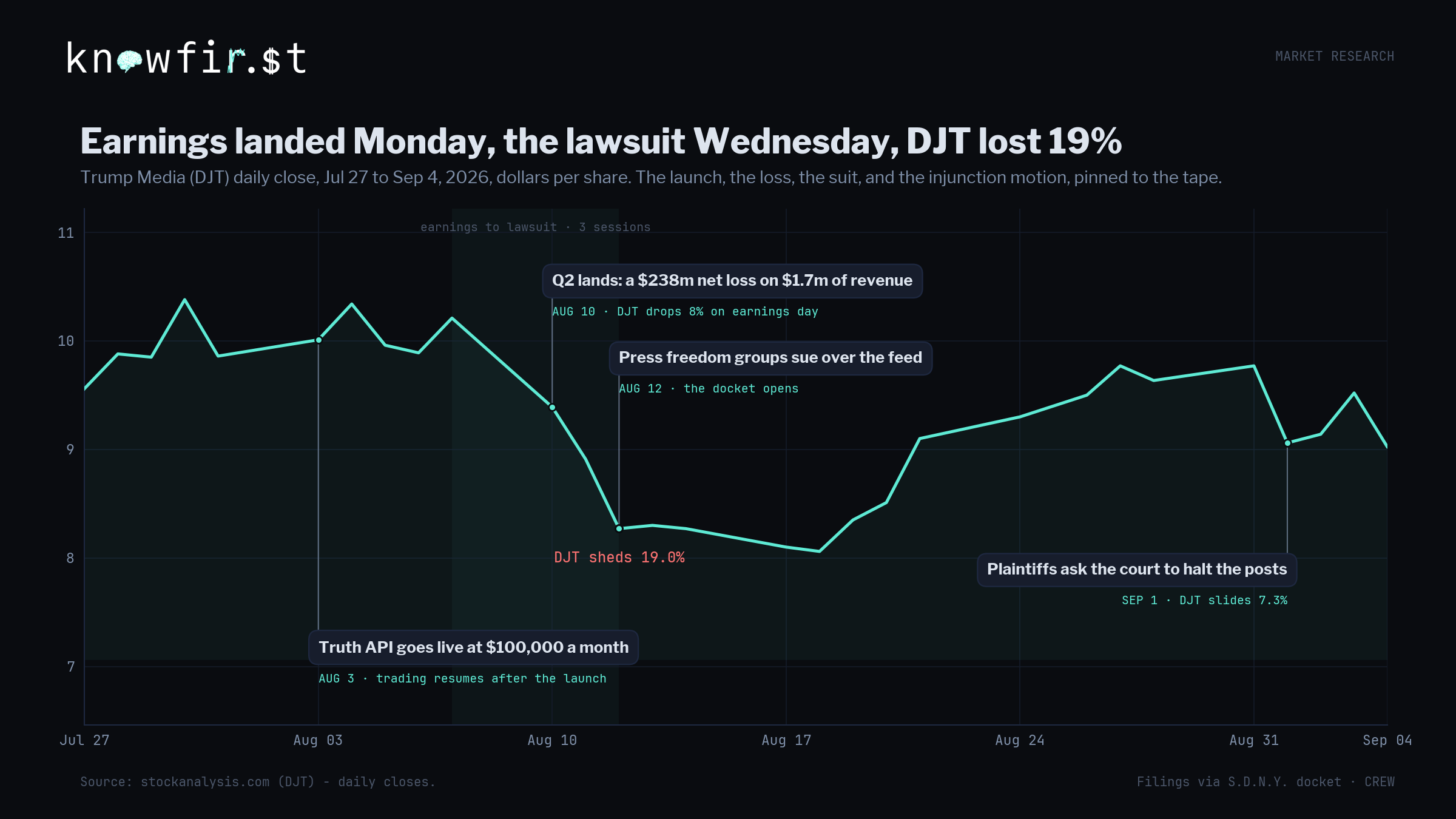
On Monday, August 10, Trump Media reported a $238m net loss on $1.7m of revenue for the second quarter, "$1.43m from advertising and $179,500 from subscriptions", with "$190.4m in unrealized losses on digital assets" doing most of the damage. DJT dropped 8% on earnings day.
Part two was the docket:
On Wednesday, August 12, The Intercept and the Freedom of the Press Foundation sued the president, executive assistant Natalie Harp, deputy chief of staff Daniel Scavino, the Executive Office of the President, and the White House Office in the Southern District of New York, docketed as No. 26-cv-6867. The argument is simple to state: the president's posts are official statements, official statements are public information, and selling early access to public information violates the First and Fifth Amendments. Seth Stern, the foundation's advocacy chief, put it this way:
"A president selling priority access to news he himself generates for the benefit of a private company he controls is so blatantly corrupt and unconstitutional that it would have been hard to even fathom just a few years ago."
A company spokesman told CBS News that Truth API resembles subscription products from "countless platforms and news outlets" and called the suit an attempt to "weaponize the courts to censor him again and harm our shareholders."
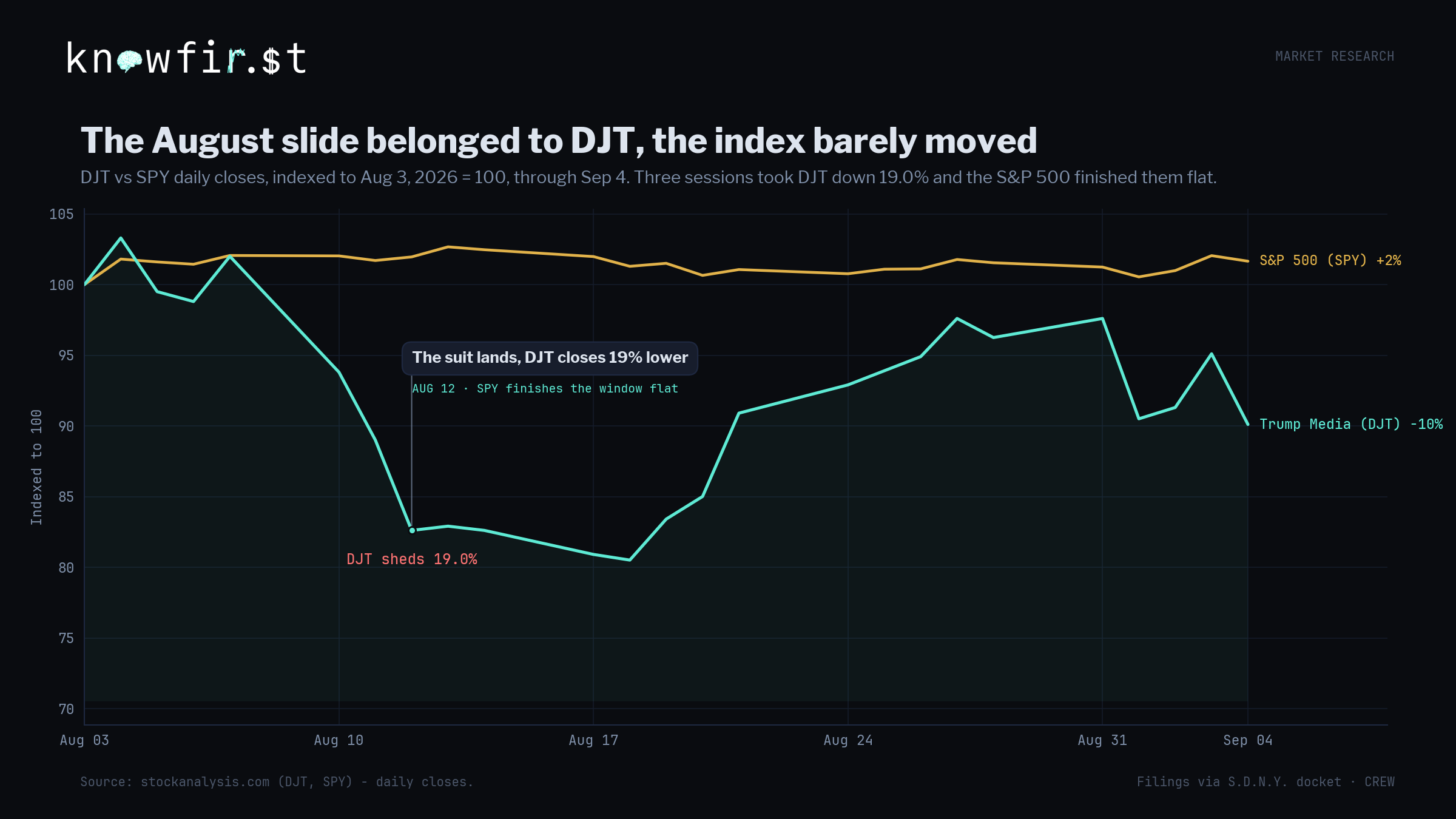
The tape kept score. DJT closed that Wednesday at $8.27, down 19.0% in the three sessions from its August 7 close of $10.21. The S&P 500 finished those same three sessions flat.
The revenue the caption leaves out
Trump Media is absent from the case caption.
The defendants are the president and his staff, because the theory of the case is about official conduct. Yet the company's income statement is where the stakes live.
At the published prices, ten clients are worth somewhere between $600,000 and $1m a month, call it $1.8m to $3m a quarter. The entire company booked $1.7m of revenue in the second quarter. That comparison is back-of-the-envelope run-rate arithmetic on reported figures, contracts can churn, and none of it is investment advice. It still frames the fight: the product this lawsuit aims at may be the largest revenue line Trump Media has.
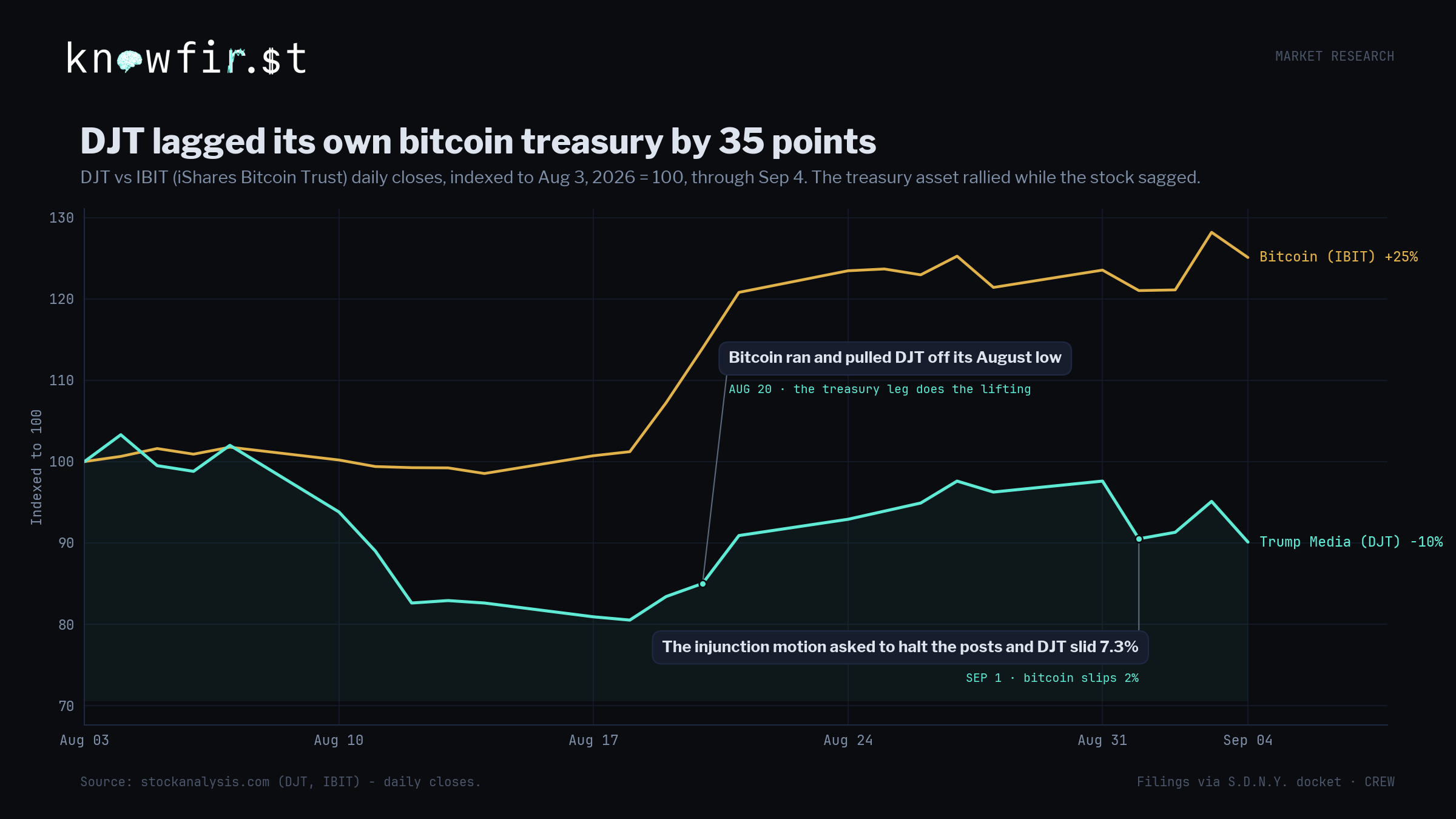
Which is why September 1 matters. That day the plaintiffs moved for a preliminary injunction asking the court to bar the defendants "from posting on Truth Social so long as the president can profit from selling early access to government information." Co-counsel at CREW stated the theory in one line: "President Trump cannot be allowed to continue to violate the First and Fifth Amendments for the sake of his personal profit." Yale's press-freedom clinic, which represents the plaintiffs, was blunter still: "Truth API is the work of a president who seems to be using his office to serve himself rather than the American people." DJT slid 7.3% that session, while the S&P 500 dipped 0.7% and bitcoin slipped 2%.
Reality check
The honest complication is that the three-session slide had two catalysts. A $238m quarterly loss is a fat one, it landed first, and there is no clean way to apportion 19 points of drawdown between a bad income statement and a new docket. What the tape does support is narrower: the move belonged to the company.
The index was flat across the window, and bitcoin, the asset Trump Media famously keeps as its treasury, fell only about 2.5% while DJT fell 19. The stock's August problems were its own.
The recovery cuts the other way. From August 18, bitcoin ripped, and DJT rode it off its $8.06 low: from August 3 through September 4 the iShares Bitcoin Trust, ticker IBIT, ended up 25% and the S&P 500 up 2%, while DJT still ended down 10%, a 35-point gap to its own treasury asset.
The motion hit the docket and the stock slid 7.3% the same session; I cannot prove one caused the other, and the day's broad risk-off tone plus the 2% bitcoin dip plausibly account for a piece of it. The case itself can also fizzle: the government has procedural defenses, the "countless platforms and news outlets" analogy will get its day in briefing, and a dismissed suit leaves the feed selling exactly what it sells today. As of the September 4 close, the last before this post, DJT sat at $9.02.
The premise, sworn
This case sits unusually close to home. knowfir.st exists because primary sources move markets and most people read them late. The lawsuit takes the same premise and swears it into a federal record: ten trading firms, by revealed preference, believe that reading the president's posts "milliseconds" early, per the reported licensing terms, is worth six figures a month.
The court will decide a different question: whether that head start on official government information can lawfully be sold at all. Whichever way it rules, the finding underneath is already on the record, priced at $100,000 a month and climbing a docket in Manhattan.
When the next market-moving post hits the feed, which side of the reading order will you be on?
knowfir.st watches Truth Social alongside 30 other primary-source feeds, from SEC filings to CENTCOM releases, and emails you the source link with an impact read minutes after it drops. The paying firms buy milliseconds; email buys you minutes. Your first feed is free, and the full service is $29.99 a year.