
The SEC exemption that named its own winners in the fine print
On September 17, 2026 the SEC published the order that sets the terms for onchain trading in US stocks, and the decisive part of it is a definition. Release 34-106402 hands a five year exemption to a new category of trading venue, then spends one sentence saying which tokenized shares are eligible for it. Tokens carrying real shareholder rights qualify. Tokens that only track a price do not. That session Coinbase (COIN) closed up 5.7%, Circle (CRCL) up 5.8% and Robinhood (HOOD) up 5.2%, while the iShares Bitcoin Trust (IBIT) added 0.6% and the S&P 500 tracker (SPY) added 1.1%.
The tokenized-stock read that analysts attached to Coinbase, Robinhood and Circle a day later started from a public document anyone could open on September 17.
The sentence doing the sorting
Chairman Paul Atkins introduced the exemption in the SEC's release as a way to "bring America's capital markets into the digital age by facilitating onchain trading of certain tokenized stocks." The conditions underneath that sentence are where it gets specific. The order defines a Tokenized NMS Stock, then carves out what it will not accept:
Tokenized NMS Stock does not include securities where a third party issues a crypto asset representing its own security that provides synthetic exposure to an underlying security, such as a tokenized linked security or a tokenized security-based swap.
And it makes the venue check the difference itself:
A TSV must verify that the Tokenized NMS Stock made available for trading on the TSV provides holders the same rights and privileges as does traditional NMS stock of an equivalent class.
Hold those two conditions next to the products that already exist and the sorting does itself.
Who the conditions already described
Coinbase put tokenized stocks live on Base on August 24, each token a direct claim on the underlying share with dividends attached. That is the structure the order describes.
Robinhood's European stock tokens are a different animal, and Robinhood is the one who says so. Its EU site carries the line in plain text:
Classic Stock Tokens are derivative contracts between you and Robinhood. They are priced at the prices of the underlying securities without granting rights to them.
Priced at the underlying, granting no rights to it. That is the shape the carve out excludes, described by the company being excluded.
Circle sits one layer down, in the plumbing. The order limits what a tokenized share may trade against inside a pool: another tokenized stock, a tokenized money market fund, or "a non-security crypto asset (e.g., a payment stablecoin issued by a permitted payment stablecoin issuer)." The settlement leg is written into the eligibility conditions.
The order came first, and you can check that
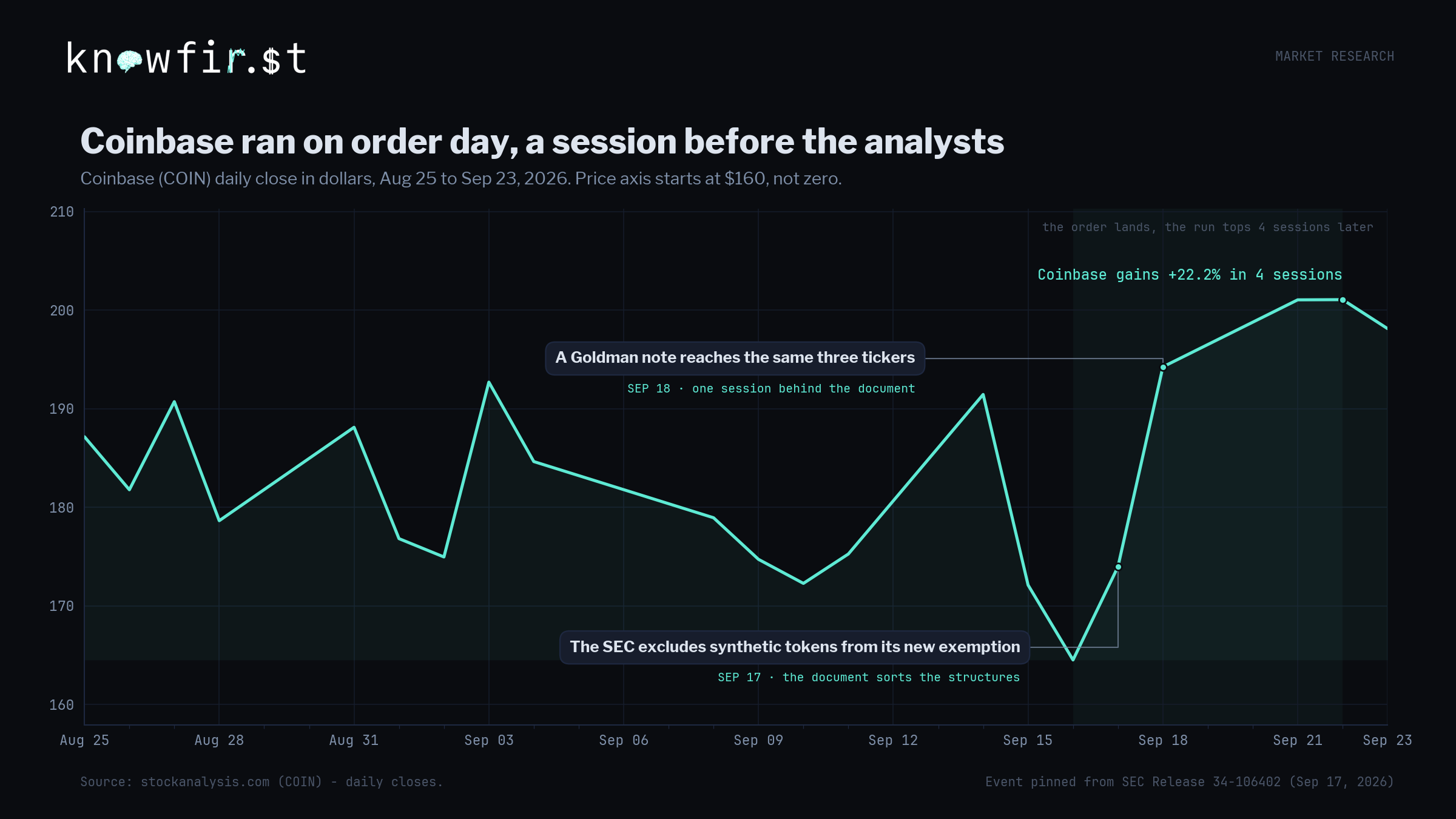
CoinDesk logged the release on Thursday morning, September 17, hours before that session closed. The Goldman Sachs research report that reached Coinbase, Robinhood and Circle is dated September 18 according to TechFlow, one session later. CoinDesk's writeup of the analyst calls ran on September 20. By the time the second-hand version arrived, the first leg had already happened.
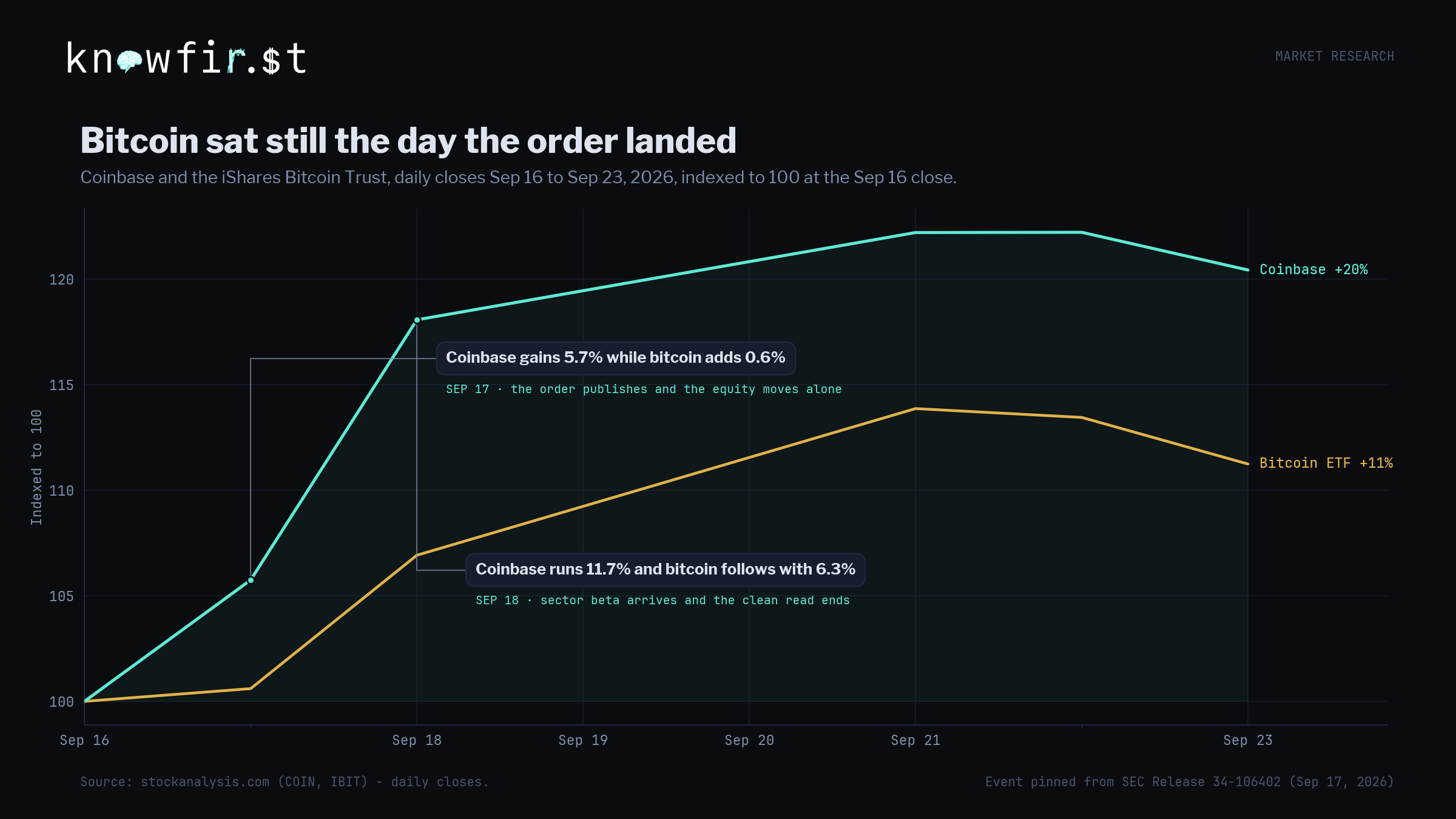
September 17 is the session that separates cleanly. Coinbase gained 5.7% that day while bitcoin, through IBIT, added 0.6%. Whatever moved the equity was leaving the asset class alone.
Reality check
Two things cut against the clean version of this story, and both are worth more than the clean version.
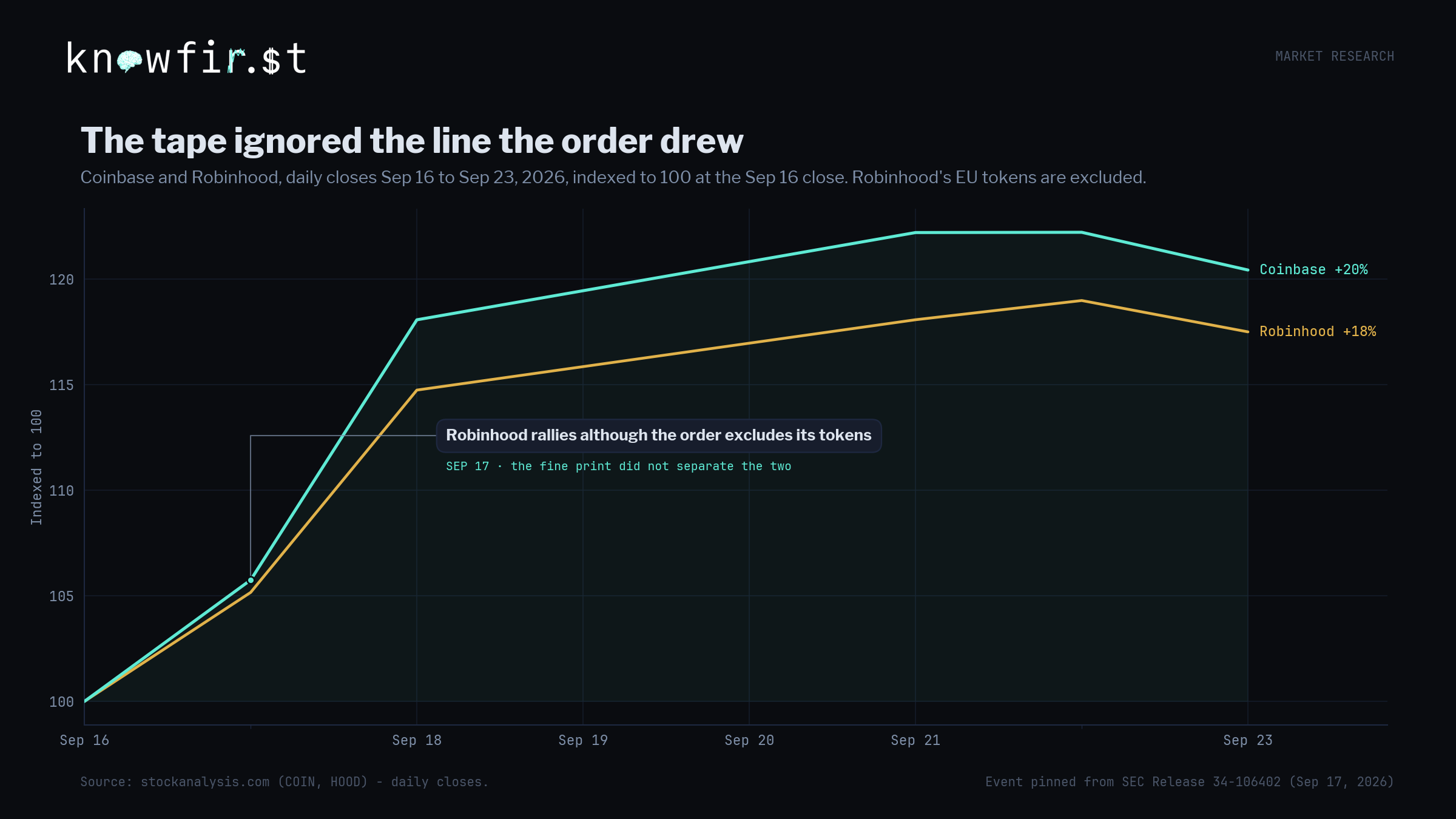
The tape never priced the order's own dividing line. Robinhood, whose current tokens that definition excludes, ran +17.5% from the September 16 close through September 23, against Coinbase's +20.4%. Traders bought the theme and left the fine print alone, which is the opposite of what "the document named its winners" would predict.
And everything after September 17 is contaminated. On September 18 Coinbase ran another 11.7%, but bitcoin came with it this time, adding 6.3% that session and 11.3% from the September 16 close through September 23 while a broad crypto rally ran. The Fed had also raised rates on September 16, so some of the September 17 bounce is a recovery out of that hole. One clean session is a thin sample.
The hindsight number, with its label on
Buying the September 16 close in Coinbase and selling the September 22 close would have been +22.2% in four sessions, which is best-case hindsight on a single selected example and not investment advice.
The window ends at the September 22 peak because that is where the run topped out, and it starts at the September 16 close because that is the last print before the order existed. Since then Coinbase has given some of it back: it closed at $198.13 on September 23, down about 1.5% from the $201.07 peak, and that is the last close before this went out.
The document is still the live text
Nothing is trading under this exemption yet. The order requires that "at least 30 calendar days before operating, a TSV must publish a copy of a notice," so the earliest any venue can switch on is well into October. The first tier "cannot exceed 75 symbols traded." Those caps live in the conditions, and most of the coverage has skipped straight past them to the headline.
The whole read was legible in the eligibility language on the morning it published, in a document anyone could open. So when the next order like this one lands, where will you be reading it?
knowfir.st watches primary sources, from SEC releases to agency wires, and emails you the ones that matter with a short read on why they matter to markets. Your first feed is free.