
Reading the Tape Before the Shock
How the 2026 Iran war got narrated in plain sight, and why the market did the opposite of what everyone expected
An oil shock was coming. And the strange part? It was being announced in real time, on Truth Social, in front of everyone.
It's easy to draw a straight line through the past and call it wisdom, but the claim is narrower than that, and I think more interesting: the signals were dated, public, and readable before the first missile flew. A perceptive investor didn't need a source inside the Pentagon. They needed to read the posts, and take Iran's own behavior seriously.
I started knowfir.st because I finally realized how much "Truth" from the President was impacting my portfolio and my timing. I'd like to walk through the past, what I wish I would've seen, and how it all worked out in real time.
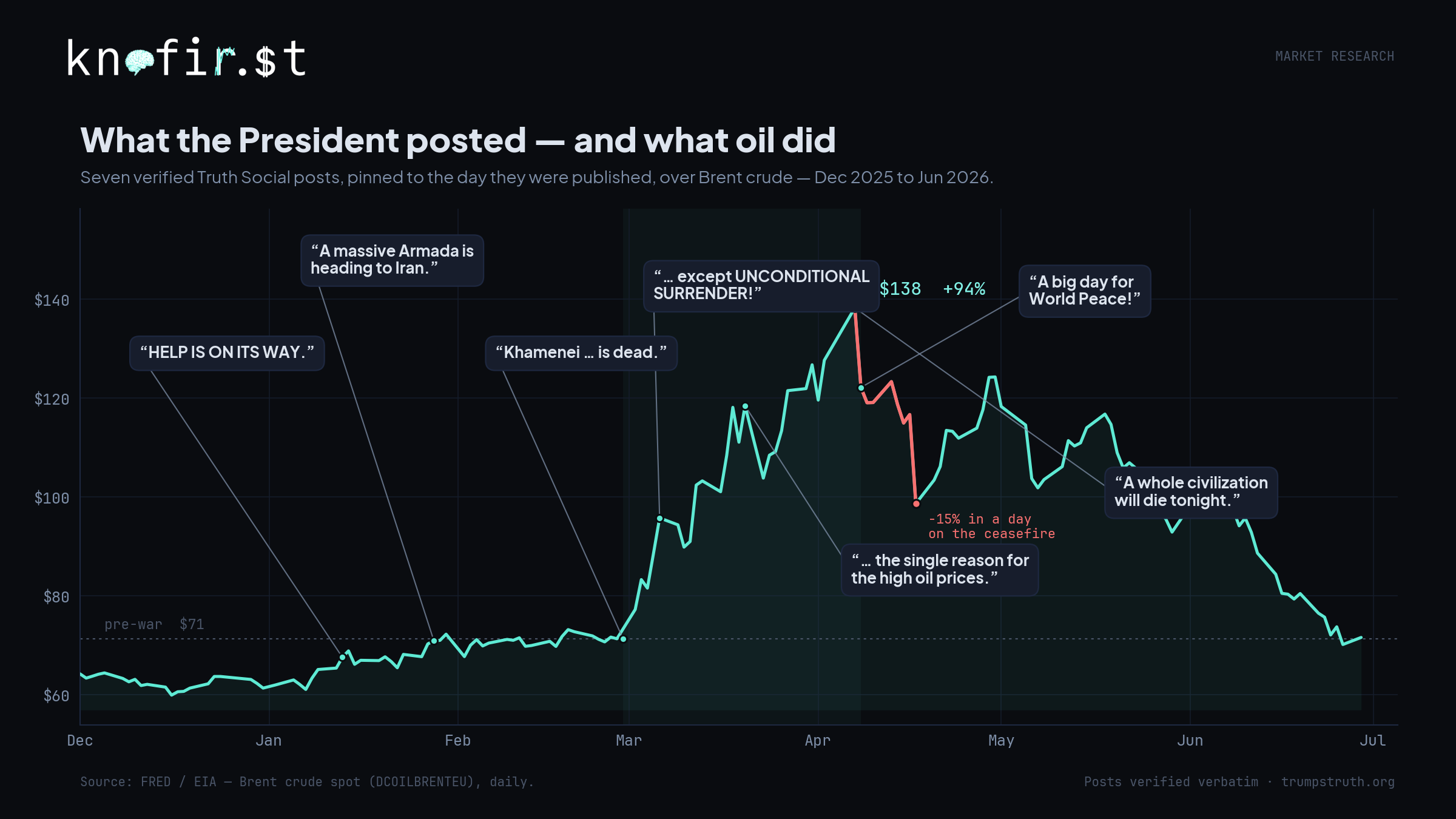
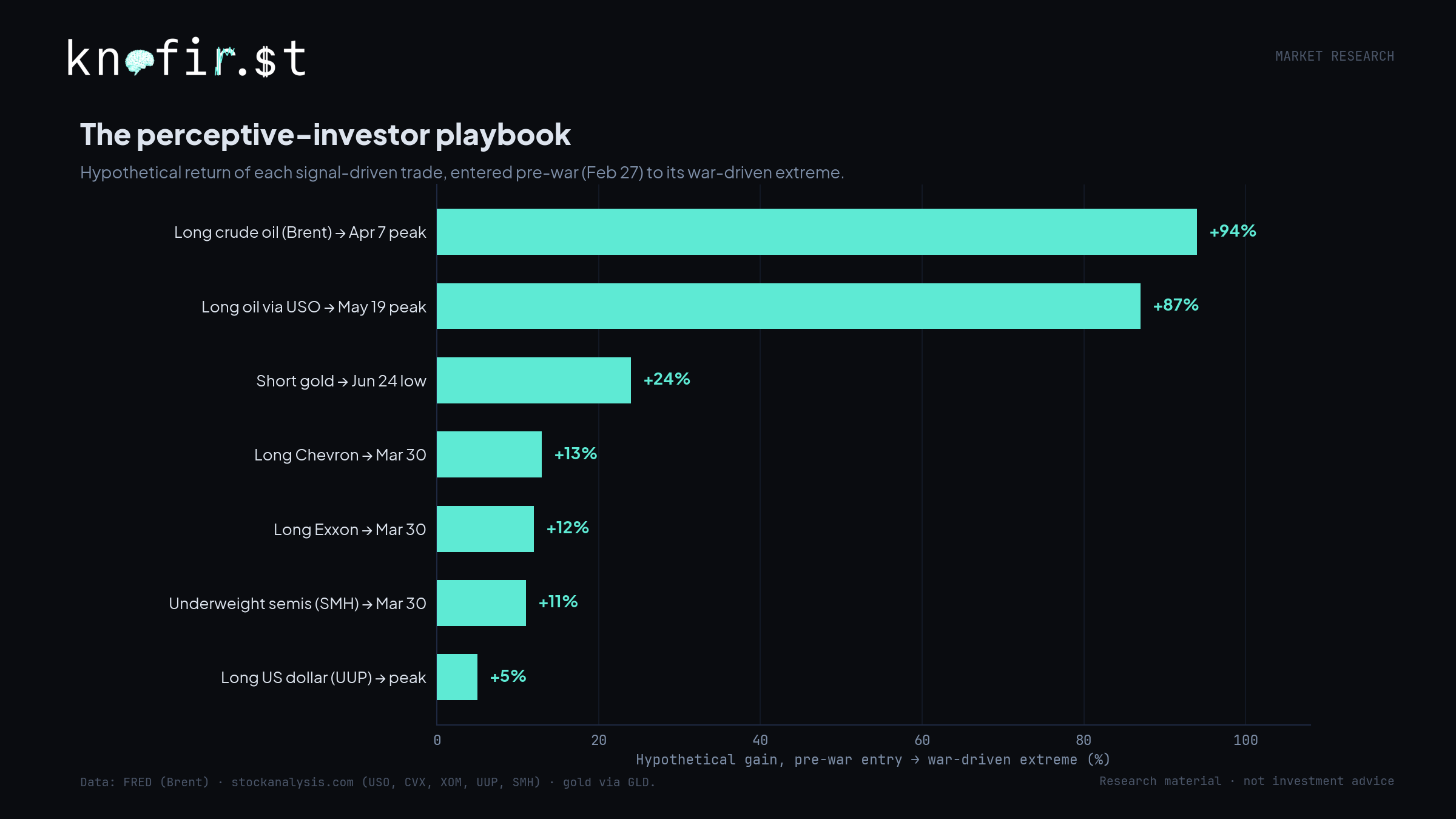
Here's the whole thing in one picture, and then let's walk the trail.
The run-up nobody had to guess at
Start with the standing policy. Back in February 2025, NSPM-2 restored "maximum pressure" and ordered Iran's oil exports driven to zero. That order is the always-on trigger sitting under this whole story. Take a major exporter's barrels off the market and, sooner or later, price does the math.
Then the pressure started telling.
- December 2025: the rial collapses to a record low. A regime under that kind of stress gets cornered, and cornered regimes escalate.
- January 13 (9:43 AM): "HELP IS ON ITS WAY."
- January 28: "A massive Armada is heading to Iran…", the Abraham Lincoln, by name.
- February 20: a literal ten-day ultimatum. He'd later brag about it: "I gave Iran ten days."
Any one of these is a headline. Together they're a countdown.
Then comes the tell inside the tell, and it's the part I'd tattoo on a napkin. In mid-February, Iran itself tripled its oil exports to a record "oil-on-water" hoard. Sit with what that means. The party with the most information about whether a war was coming was quietly hedging its own supply. When the person holding the cards starts protecting his hand, you don't need to see the cards. That's the trade.
And then, right on cue, February 27: a diplomatic "breakthrough." The kind of headline that makes you exhale and cover your position, one day before the strikes. A contrarian trap, perfectly timed.
The shock, and the receipts
February 28: "Khamenei… is dead." The war begins. Within days the Strait of Hormuz chokes, and Brent runs from a pre-war $71 to a peak near $138, up 94%.
What makes this one unusual is that he put the oil story on the record himself, in his own words, as it happened:
- March 8: the war is "a very small price to pay."
- March 20: he calls it "the single reason for the high oil prices."
- March 31: "Go get your own oil!"
You rarely get a narrator this generous. And it cuts both ways. At the very top came "…except UNCONDITIONAL SURRENDER!" Then, on the turn: April 7, "A whole civilization will die tonight," into April 8, "A big day for World Peace!" Oil fell about 15% in a single day on the ceasefire. The de-escalation got posted, too.
Now the part that would've gotten you
Here's where most people got hurt, including the ones who read the war correctly.
If you know a war is coming, the instinct is risk-off: sell stocks, buy gold, pile into Treasuries. That reflex lost money this time. This was an inflationary supply shock, and when the shock comes through oil, the usual correlations invert.
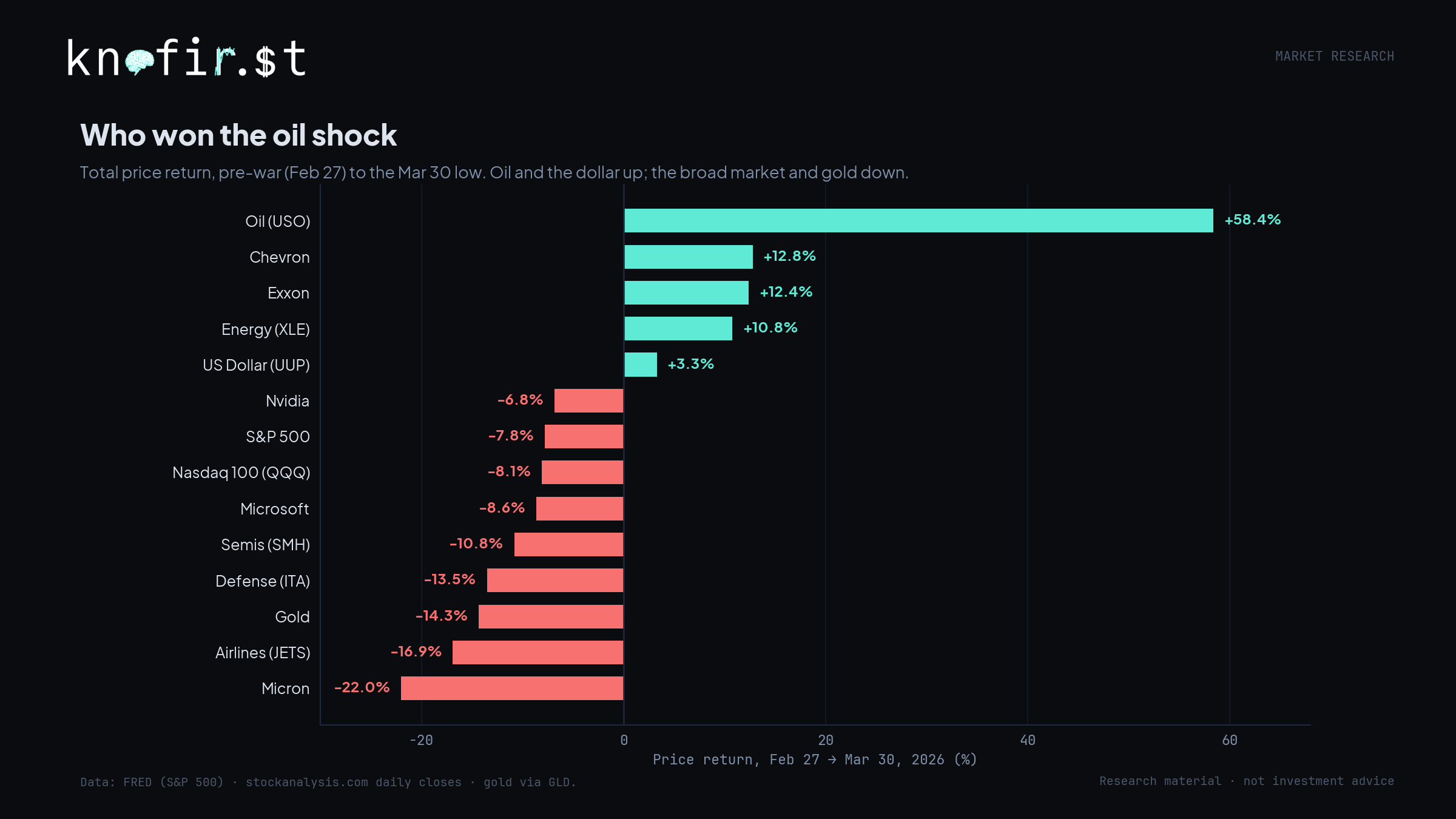
Watch what actually happened. Stocks dipped about 8% at the worst of it, then V-recovered to a record high (+11%), finishing the window up 9%. Gold, the classic safe haven, went the other way.
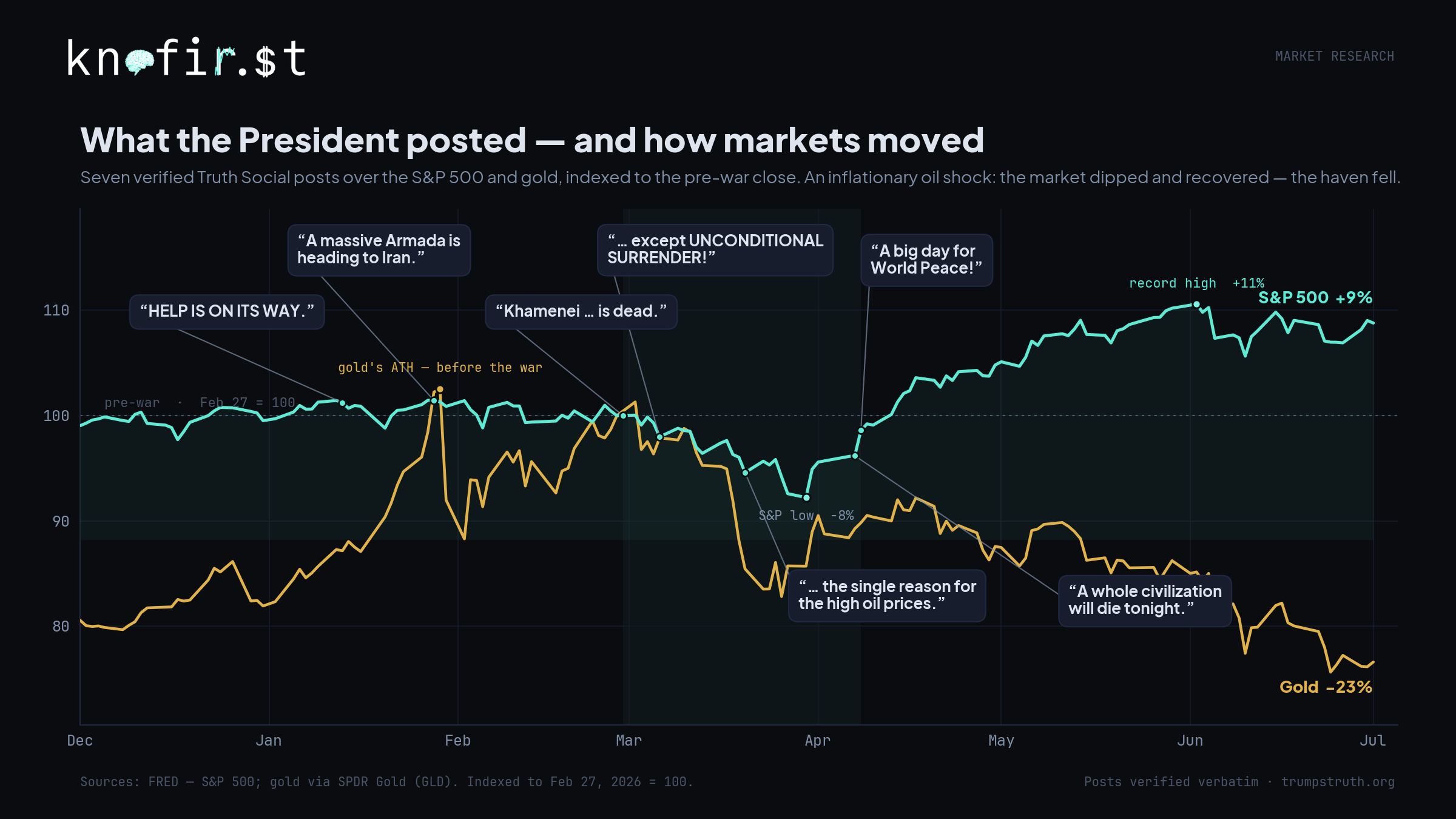
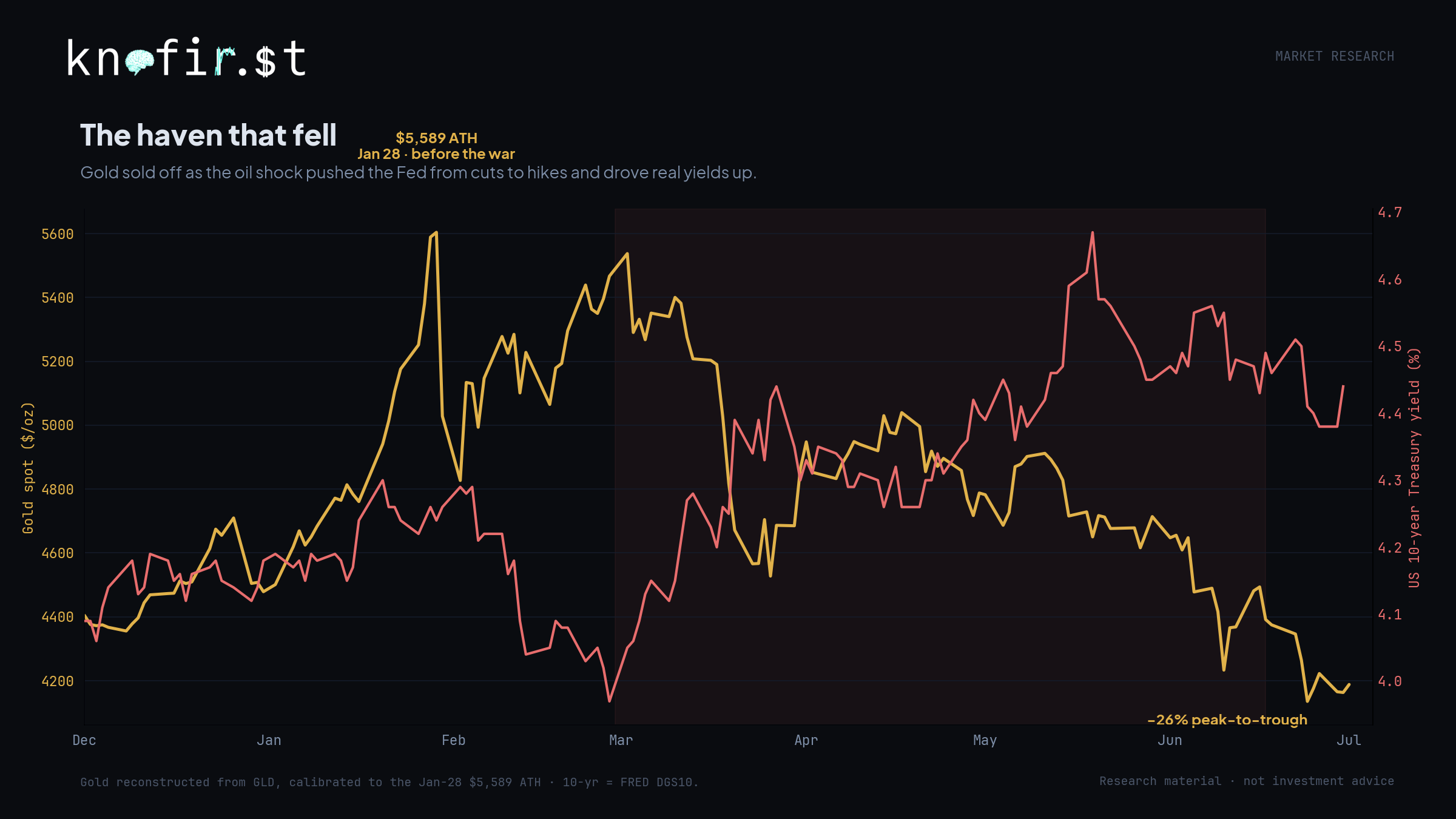
The counterintuitive star of the whole episode is gold. It printed its all-time high before the war, $5,589 on January 28, then fell ~23% off the pre-war level (about −26% peak-to-trough) while the missiles were flying. How does the haven asset crater during a war?
Follow the chain: oil shock, inflation expectations jump, the Fed reprices from cutting to hiking, real yields rise, and gold, which hates real yields, gets sold.
The same repricing lit up two other assets that "risk-off" says should have gone the other way. The dollar climbed ~3% to a 15-month high, and the 10-year yield rose ~47 basis points to a 4.67% peak. Dollar up, yields up, gold down. Those are the fingerprints of an inflation shock.
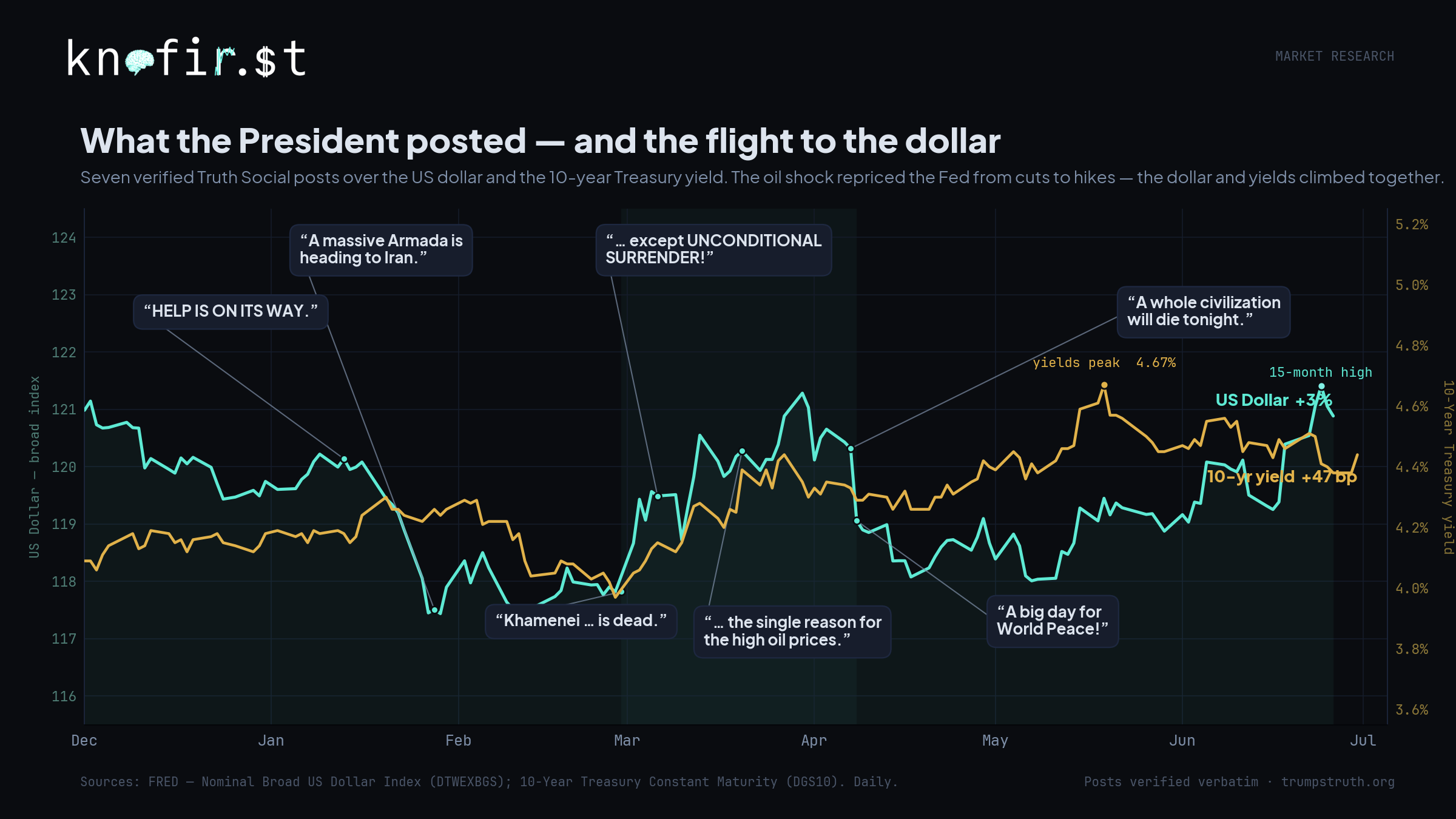
That's the whole lesson in a few assets: the transmission mechanism beats the headline. "War in the Middle East" told you to expect volatility. The direction came from the type of shock, and this one pulled supply off the market.
The playbook (and an honest asterisk)
So what would a reader who saw all this, the countdown, the tell, the type of shock, have actually done?
I'll be honest: this is best-case hindsight, and none of it is advice. But the shape is worth sitting with. Long oil was the cleanest expression, with Brent up ~94% and the oil ETF USO up around +87%. Long energy equities worked (XOM roughly +41%, CVX +36% on the quarter). The counter-consensus trades were the interesting ones: short gold into the Fed repricing, and short duration as the ten-year backed up.
Underneath the index, the dispersion was brutal, with clear sector winners and losers, energy pulling one way while rate-sensitive growth wore the higher yields.
The point
The market didn't have to infer this supply shock. It was narrated in real time by the person driving it, and confirmed by the one party with the most to lose quietly hedging its own barrels.
And if you want proof that the headline was never the signal, look at 2025. Same cast, same region, a similar Iran scare, and oil went down while gold went up. A different kind of shock that time, a demand scare, and the opposite tape.
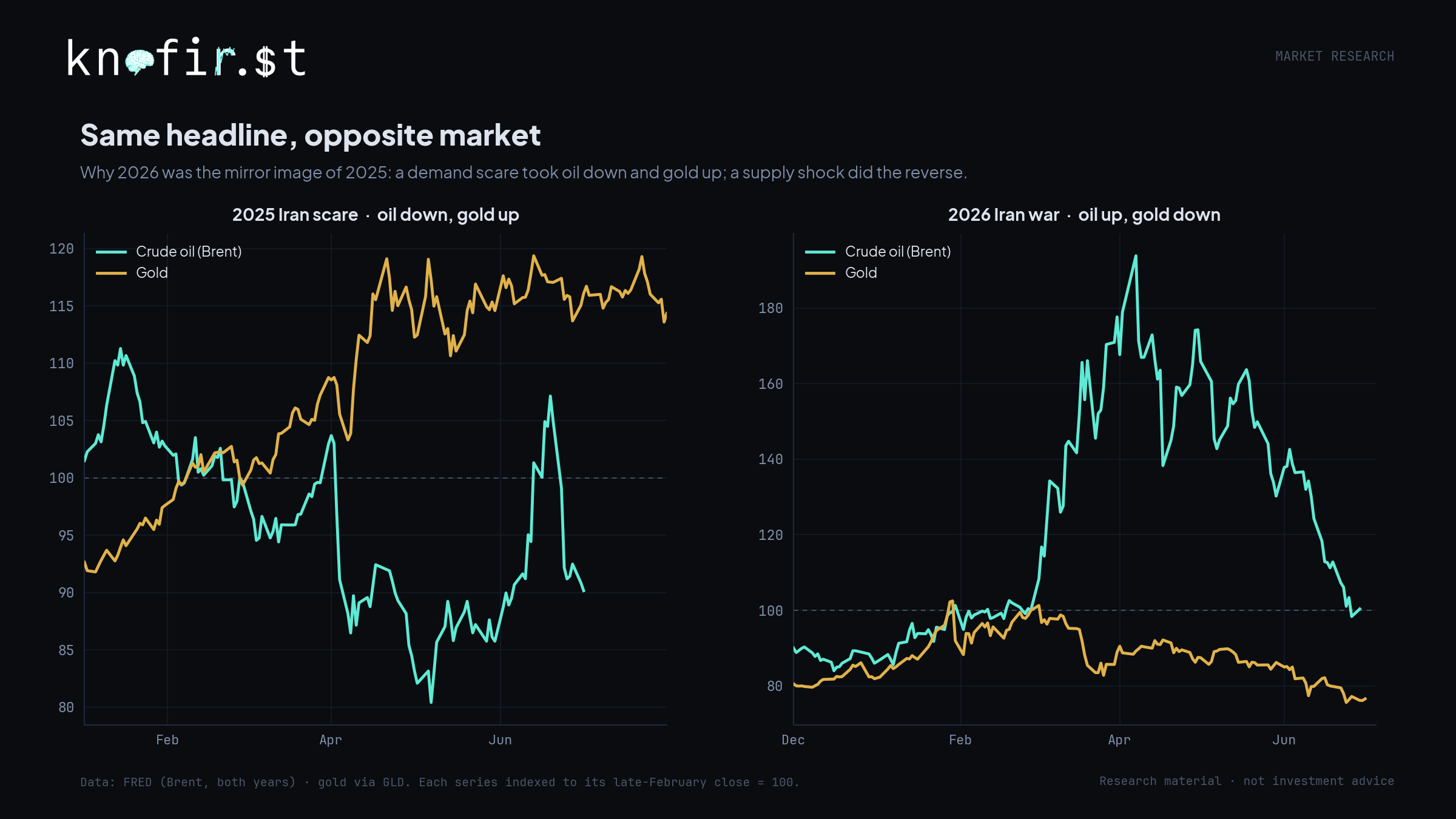
Same words on the screen. Opposite trade. The direction came down to supply versus demand, and whether the Fed had to chase inflation or could look through it.
That's the whole game, really. Read the mechanism, and the mood tends to explain itself.
So, what would you have done? If you'd been watching those posts land in real time, do you take the obvious risk-off trade, or do you trust the supply-shock read and fade the crowd?