
One summer, four documents, four double-digit runs.
On July 30, 2026, the White House posted Presidential Determination No. 2026-19, a document about scrap metal, to its public presidential actions feed.
At 20:39 UTC, 39 minutes after the close, knowfir.st emailed subscribers a plain-English read of it, naming MP Materials (MP), the American rare earth miner and magnet maker. Twenty-six days later, MP had closed 44.4% higher.
A tidy story on its own. Except it happened four times this summer. Four public government documents, each posted to a feed anyone can read, each preceded a double-digit run: 44.4% for MP Materials, 24.3% for the biotech Replimune, 20.0% for Lockheed Martin, and 18.4% for the oil fund USO.
The documents came first, every time.
The receipt, with the tickers:
That July 30 read, sent at 20:39 UTC, is the receipt we can show in full, because the move has long since played out. Verbatim, from the delivered alert:
"This activates procurement and allocation authority over recycled critical mineral streams, most directly affecting rare-earth recyclers and battery materials companies (MP, LITE has rare-earth magnet adjacency), domestic lithium and magnet processors, and EV/defense supply chains."
And it spelled out how a scrap determination reaches a share price:
"The transmission runs from government allocation authority → potential prioritization of domestic recyclers → margin support for US-based processors over import-dependent competitors."
The paper trail behind it moved fast. The determination reached the Federal Register on August 4 with its formal finding that defense requirements "cannot otherwise be met" without dislocating civilian supply, and on August 6 a BIS temporary final rule ordered US sellers of black mass and tungsten scrap to "allocate 100 percent of monthly sales to U.S. persons."
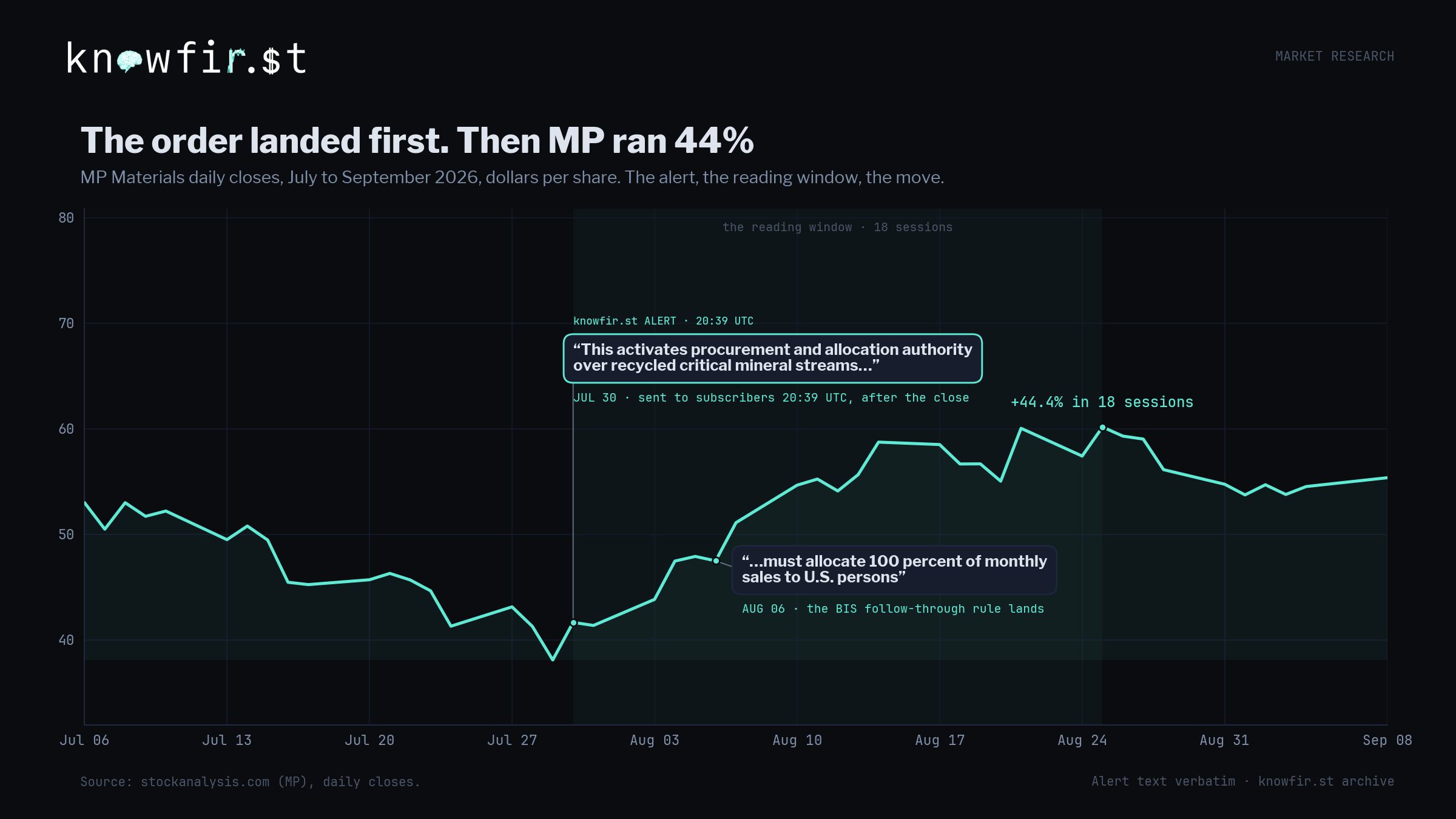
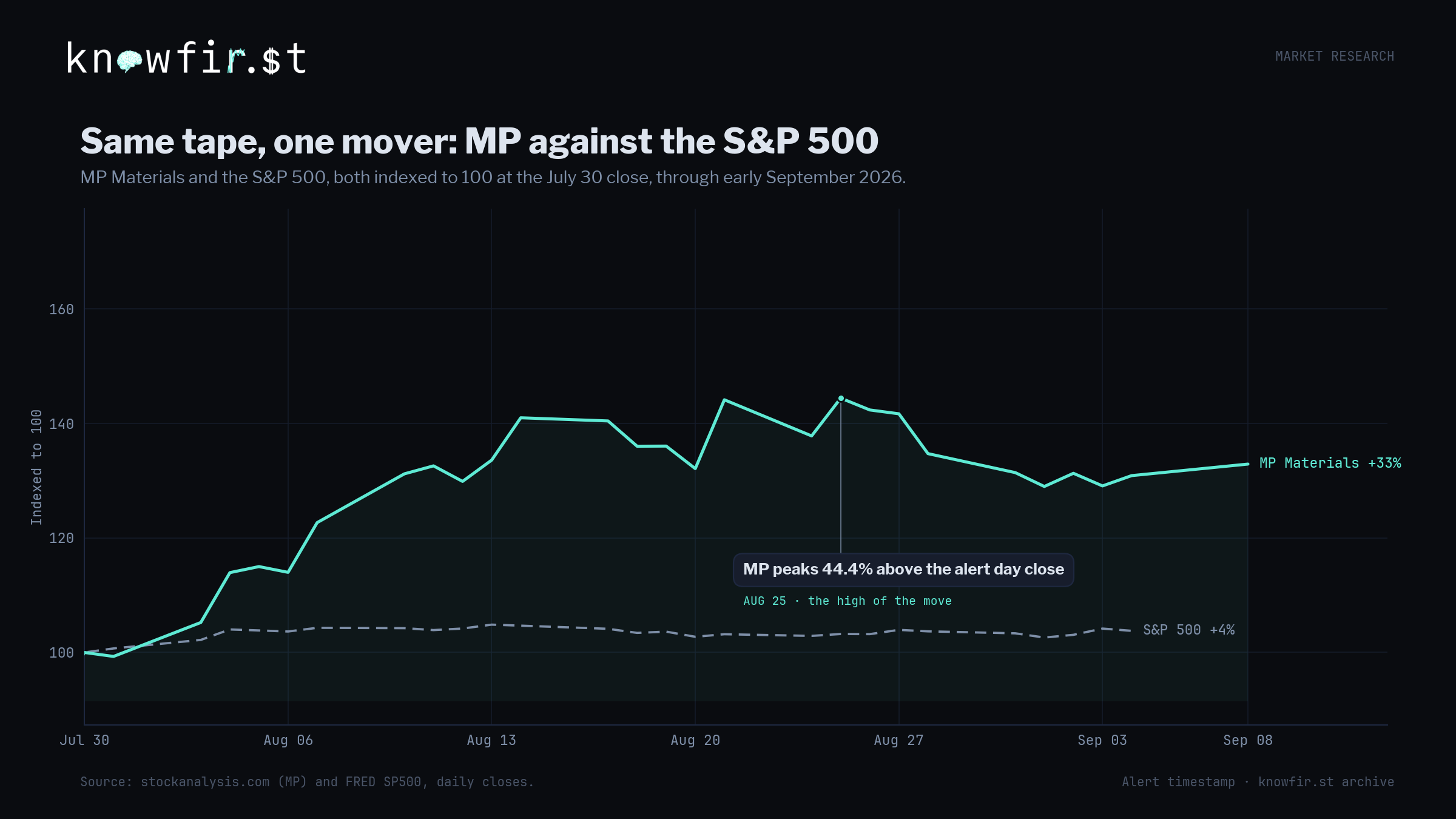
We told this story on August 17 in the scrap metal order that sent MP up 41%, when the run stood at 41.0% over 11 sessions. It topped out on August 25 at $60.17, 44.4% above the alert-day close of $41.66. That close-to-close arithmetic is best-case hindsight on a window chosen after the fact, and it is not investment advice.
For scale, the S&P 500 added about 3% over the same 18 sessions, the rare earth sector ETF REMX added 19.1%, and LITE, the other name inside that quoted line, gained 27.7%.
Two more documents, two more receipts
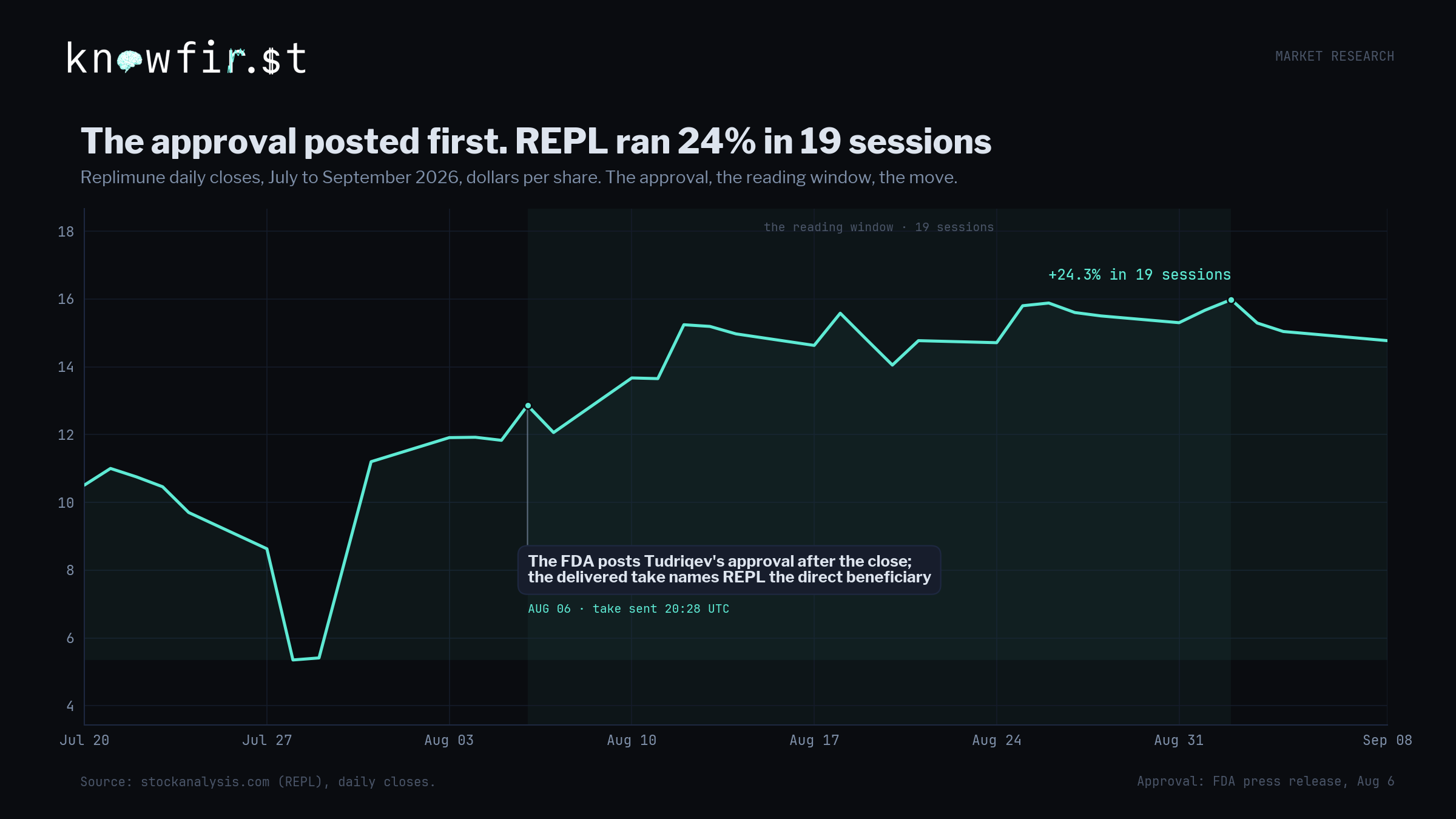
On August 6, the FDA posted an accelerated approval for Replimune's Tudriqev, an engineered viral therapy for advanced melanoma. At 20:28 UTC, 28 minutes after the close, the delivered take called Replimune (REPL) "the direct beneficiary." From that evening's $12.86 close the stock reached $15.98 by September 2, up 24.3% in 19 sessions, while the biotech ETF XBI added 7.0%.
The full story is in the FDA press release that front-ran a 23.5% biotech run.
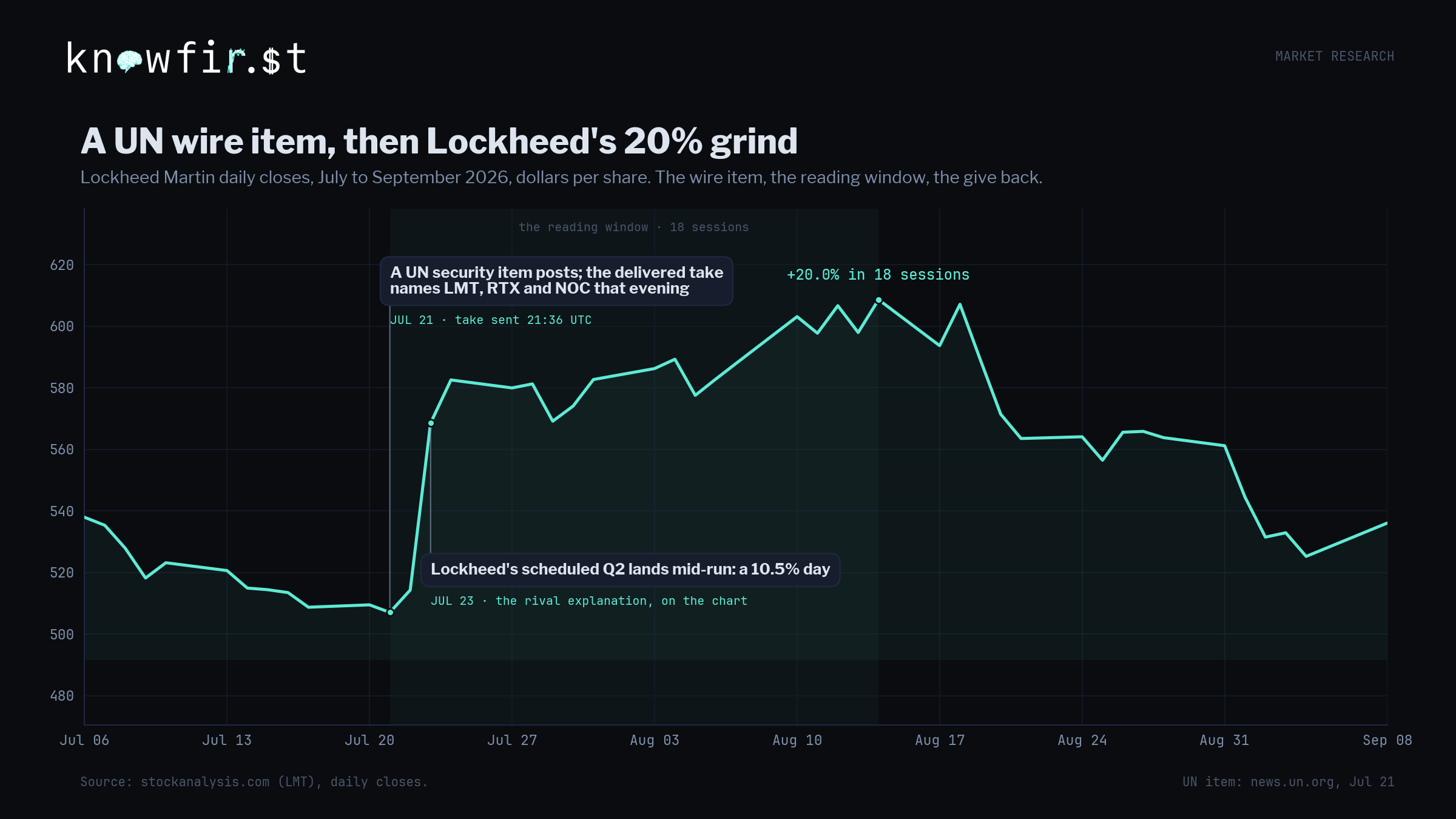
On July 21, UN News published a security item headlined "Israeli attacks on Gaza intensify amid surge of West Bank settler violence." At 21:36 UTC that evening the delivered take read: "Defense names (LMT, RTX, NOC) may see supportive sentiment as conflict duration extends." Lockheed Martin closed that day at $507.09 and closed August 14 at $608.68, up 20.0% in 18 sessions; RTX gained 15.1% and Northrop Grumman 14.4% over the same window. The full story is in a UN wire story, then Lockheed's 20% grind higher.
The fourth document, the one we never wrote up
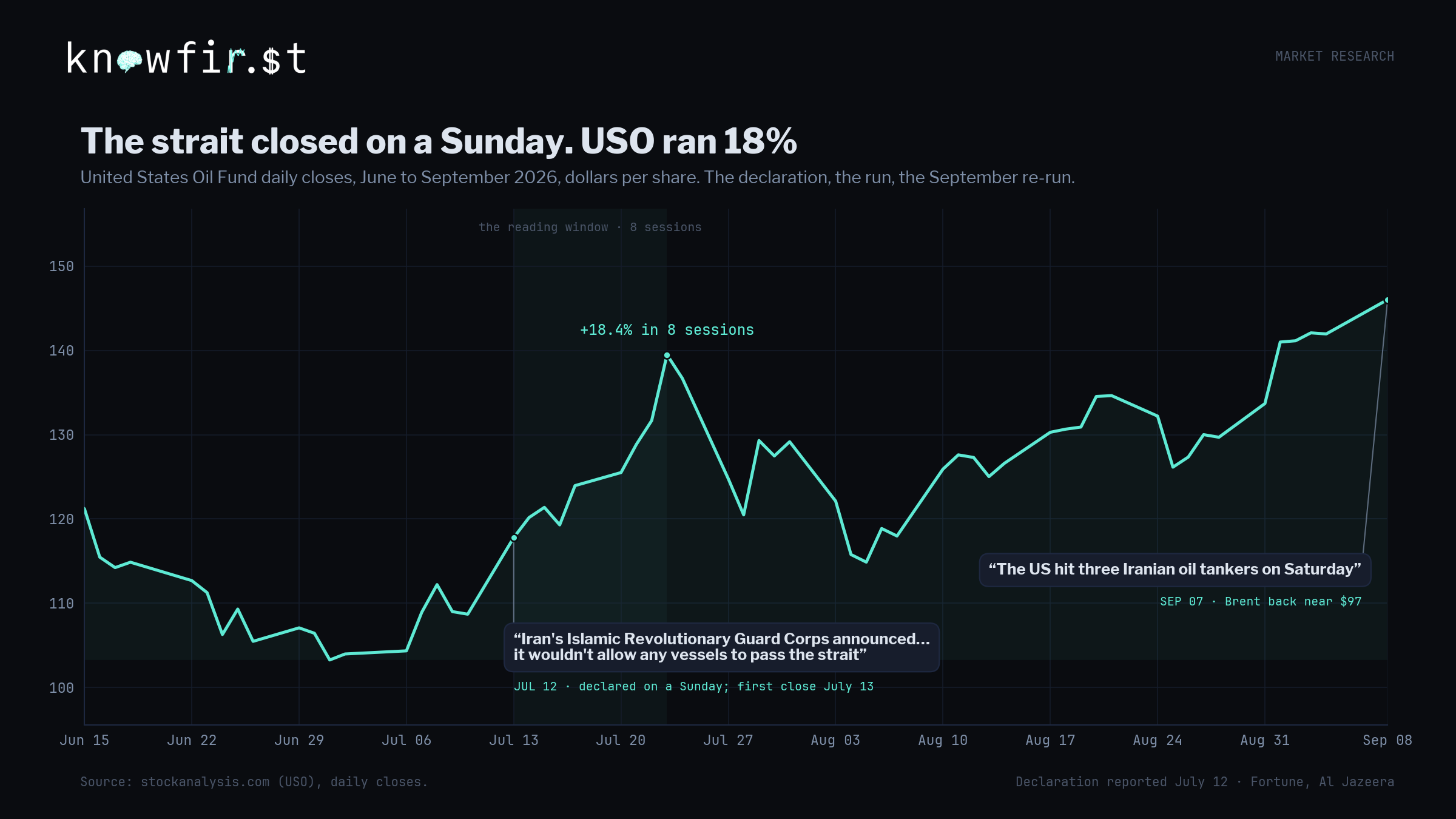
On Sunday July 12, Iran declared the Strait of Hormuz closed. Fortune reported that morning that "Iran's Islamic Revolutionary Guard Corps announced earlier Sunday it wouldn't allow any vessels to pass the strait until foreign interference ends," while the coalition's Joint Maritime Information Center said in a note that the path along the Omani coastline was "still available for transit."
The oil fund USO closed Monday July 13 at $117.79. Eight sessions later, on July 23, it closed at $139.49, up 18.4%, while the S&P 500 fell about 1.4% and Brent ran from $81.62 to $105.32.
This is the only leg that never got its own post. The tape told it anyway.
Reality check
The honest ledger first: this page is a selection.
A season of alerts includes reads that fizzled. Rival explanations also deserve their names.
Sector beta did real work in every leg, as the REMX, XBI, and defense-peer numbers above show.
Scheduled catalysts sat inside every equity window: Lockheed's July 23 earnings alone were a 10.5% day, MP reported a strong second quarter on August 6 mid-run, and Replimune's advisory committee vote had already doubled that stock in late July.
An active shooting war moves crude with no help from anyone's inbox. Preceded is the claim on this page, never caused.
What the rival readings struggle to explain is sequence and spread. MP outran its own sector ETF by 25 points. The S&P 500 fell over the USO and REPL windows, so market beta subtracts there rather than adds. And in all four cases the document preceded every session of the run.
Where they stand, September 8
Peak endpoints flatter any table, so here is the after.
- MP closed September 8 at $55.37, still 32.9% above the alert-day close against about 4% for the S&P 500 since July 30.
- REPL sits at $14.77, holding 14.9%.
- LMT gave most of its run back and sits at $536.15, up 5.7%.
- USO closed at $146.03, above even its July peak, and per Al Jazeera on September 7, Brent is back near $97, "up 9 percent over the last five days and 19 percent over the last month" after the US "hit three Iranian oil tankers on Saturday." The fourth leg's mechanism is running again this week.
All of the window arithmetic above is hypothetical, selected, best-case hindsight, and none of it is investment advice.
A scrap determination, a drug approval, a UN wire item, a Sunday shipping declaration. Different agencies, different feeds, one behavior: the document posts, the market takes days to finish the arithmetic. Somewhere on a government server the next one is already queued. When it posts at some 4:39 in the afternoon, what will be open on your screen?
knowfir.st watches 36 primary sources, the White House, FDA, and UN feeds among them, and emails subscribers the documents that matter with a plain-English read on why, minutes after they post. Delivery speed is measured and published on the homepage. The first feed is free.